Dew point and bubble point on a refrigerant P/T chart
Label the refrigerant, pressure reference, point on the chart and measured pipe temperature before handing over P/T readings.
HVAC Leak Check editorial team · References checked
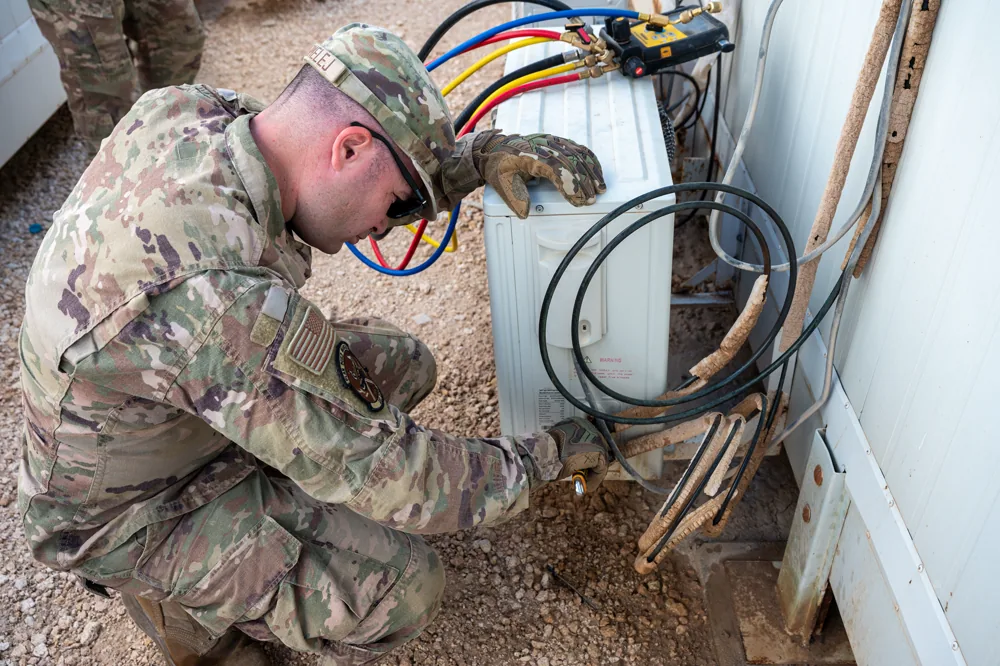
The instrument and connection belong in the same observation record.Photo: U.S. Air Force AFCENT by Senior Airman Grace Turpin · Public domain
For a zeotropic blend, the dew and bubble temperatures at a given pressure can differ. “Dew” refers to the saturation boundary at which the last liquid evaporates on heating, or the first liquid condenses on cooling. “Bubble” refers to the boundary at which the first vapour forms on heating, or the last vapour condenses on cooling. The chart value is a saturation reference, separate from a measured pipe temperature.
Keep four labels with a chart value
Record the documented refrigerant, the pressure and whether it is gauge or absolute, the selected dew or bubble reference, and the source of the P/T data. Give the pipe temperature its own field with the probe location and operating state. When checking superheat, the usual saturation reference for a zeotropic blend is dew; for subcooling it is bubble. Confirm the equipment manufacturer’s instructions and the measurement point.
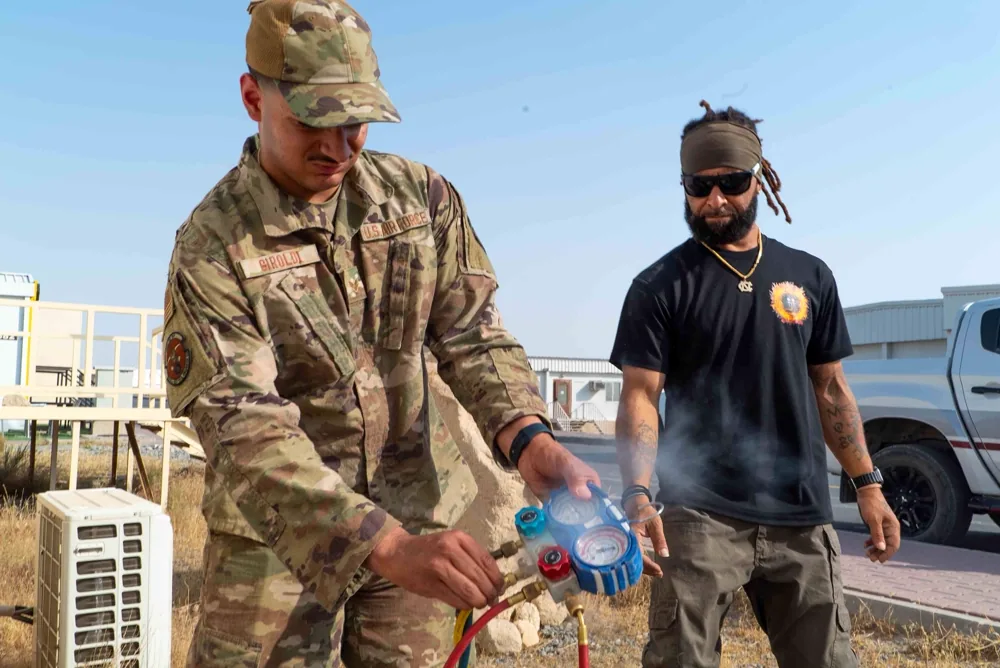
A manifold and hoses require their own documented measurement reference.Photo: U.S. Air Force photo by Senior Airman Mark Colmenares · Public domain
Query inconsistent records before drawing a conclusion
If two instruments display different temperatures at what looks like the same pressure, compare the refrigerant selection, pressure basis and chosen saturation reference. Check the source/version and the point to which the reading applies. A change from bar to psi does not switch from gauge to absolute. Use a manufacturer chart or reference tool such as the Danfoss slider for the refrigerant P/T relationship.
Common questions
Is the P/T chart result a sensor reading?
No. It is a reference calculated or looked up for the specified refrigerant and pressure. Keep the actual measured temperature separate.
Which saturation reference would I normally label for a superheat observation on a blend?
Normally use the dew reference for a vapour-side superheat observation and label it as dew. Confirm the refrigerant, the chart and the equipment procedure.
Which chart reference is normally used in a subcooling observation on a blend?
Normally use the bubble reference for a liquid-side subcooling observation and label it as bubble. State which pressure you used to look up that value.
How do I keep the measured line temperature and chart reference in separate fields?
Give the measured temperature its own field with pipe location and time. In a separate field, record the chart temperature, refrigerant, dew or bubble, the pressure and its reference.